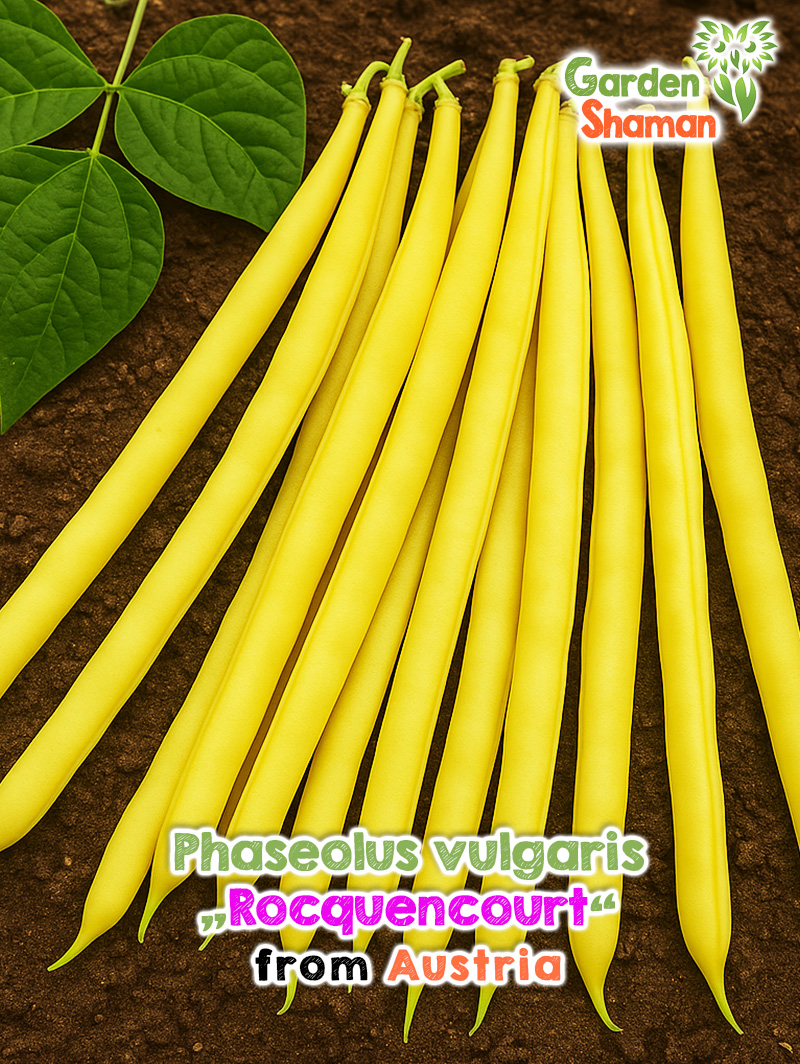
Rocquencourt bush bean (Phaseolus vulgaris) – seeds
$ 2.57
Description Rocquencourt bush bean (Phaseolus vulgaris) – seeds Seed information Origin: Austria Harvesting the seeds: 2025 Germination period: 8–14 days at 18–25 °C. Each packet contains approx. 15 seeds. Larger quantities available on request. Information on the species Family: Fabaceae (leguminous plants) Synonyms: Haricots beurre ‚Rocquencourt‘, yellow bush bean, butter bean ‚Rocquencourt‘ Occurrence: Cultivated garden variety of French origin Type of use: Vegetable plant / Legume The bush bean Phaseolus vulgaris ‘Rocquencourt’ is a traditional French variety with golden yellow, tender pods and a particularly delicate, buttery flavor. The variety originates from the Rocquencourt region near Versailles and has been prized for decades for its early maturity, rich yield, and exceptional pod quality. The plants grow bushy and compact, reaching a height of around 40–50 cm, and do not require any support – ideal for beds, raised beds, or balcony pots. Their pods are round, 12–14 cm long, bright yellow, and retain their delicate texture even after cooking. A classic variety that combines French elegance and agricultural tradition. Sowing instructions �� Sowing time: From mid-May to July, once there is no longer any risk of frost Germination period: 8–14 days at 18–25 °C Seeding depth: 2–3 cm Substrate: Loose, humus-rich, well-drained garden soil Location: Sunny and sheltered from the wind Pouring: Keep regularly and evenly moist Planting distance: 30 × 40 cm or row spacing 40 cm �� Tip: Soak the seeds in lukewarm water overnight before sowing – this significantly accelerates germination. Cover with fleece if the soil is cool to ensure even soil temperatures. Use & meaning �� ‘Rocquencourt is a true gourmet variety and is prized in France as a ’haricot beurre„ (butter bean) – a reference to its delicate, creamy texture. The yellow pods retain their color and delicate aroma even after cooking, making them ideal for salads, vegetable stir-fries, side dishes, or stews. As a traditional variety, it combines enjoyment and practical value: it provides protein-rich, fiber-rich food that is easy to digest and ideal for use in healthy cooking. Its light yellow pods are particularly popular with children and hobby gardeners, as they are easy to spot and harvest. In French gardening culture, ‚Rocquencourt‘ is considered a symbol of quality, consistency, and consistent flavor—a variety that retains its elegant simplicity even in modern gardens. Tips & tricks for hobby gardeners �� Regular harvesting prolongs the fruiting phase and promotes new flower formation. Never eat beans raw—they contain natural lectins that are neutralized during cooking. Ideal for mixed cultivation with cabbage, beetroot, or lettuce—improves soil fertility through nitrogen fixation. Do not apply fresh manure or nitrogen-rich fertilizers, otherwise the pods will lignify. After harvesting, leave plant residues in the soil as green manure. Worth knowing �� The Rocquencourt variety was bred near Versailles in the early 20th century and quickly became one of the most popular French bush beans. Its name, ‘haricot beurre,’ refers to its characteristic buttery flavor, which made it a staple in French cuisine. Botanically, it belongs to the species Phaseolus vulgaris, which originally comes from Central America. The European varieties were introduced after the discovery of America in the 16th century and further developed in France, Italy, and Spain. ‘Today, Rocquencourt represents the perfect balance between yield, taste, and tradition. It is not only a part of French gardening culture, but also a symbol of sustainable, aromatic vegetable cultivation. Its golden yellow pods bring sunshine to every garden—and are a treat for both the eyes and the palate.